Work Hours
Monday to Friday: 7AM - 10PM
Weekend: 10AM - 7PM
Original price was: $825.00.$389.99Current price is: $389.99.
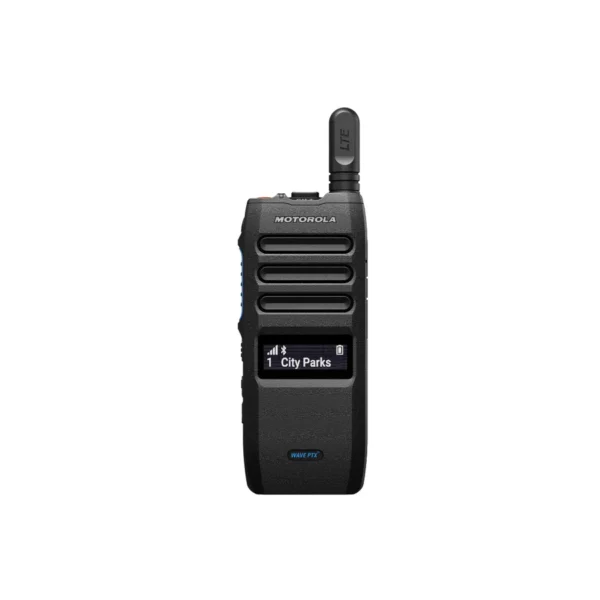
The Motorola TLK 110 Radio combines rugged two-way radio design with WAVE PTX broadband PTT, AI noise suppression, GPS/GNSS, Wi-Fi, Bluetooth and IP67 protection for wide-area professional communication.
The Motorola TLK 110 Radio brings the convenience of a professional two-way radio together with the wide-area connectivity of WAVE PTX broadband push-to-talk. Instead of relying solely on traditional radio frequencies and local repeaters, the TLK 110 uses supported cellular networks and Wi-Fi connectivity to keep teams connected wherever network coverage is available.
Compact, rugged and designed for professional use, the Motorola TLK 110 WAVE PTX Radio is an excellent choice for businesses that need simple push-to-talk communication across large areas, multiple locations or distributed teams.
Motorola describes the TLK 110 as a purpose-built radio that combines broadband PTT with rugged radio hardware, centralized device management, advanced audio and workplace safety features.
The Motorola TLK 110 is a broadband push-to-talk radio powered by WAVE PTX. Rather than operating like a conventional VHF or UHF walkie-talkie, it uses broadband connectivity to provide wide-area push-to-talk communication.
This makes it particularly useful for organizations whose employees work across cities, regions or multiple facilities and need to communicate without being limited to the coverage area of a traditional local radio system.
With the appropriate WAVE PTX service and network availability, users can communicate through the TLK 110 while also interacting with compatible smartphones, tablets and other WAVE PTX-enabled devices.
One of the biggest advantages of the Motorola TLK 110 Radio is its approach to coverage.
Traditional two-way radios typically depend on their frequency band, radio power, antenna, terrain and, where applicable, repeater infrastructure. The TLK 110 instead uses WAVE PTX broadband connectivity, allowing push-to-talk communication over supported cellular networks.
That makes it a particularly interesting solution for:
Motorola states that the TLK 110 supports PTT communication over an extended LTE network through WAVE PTX and can also support Wi-Fi calling. Actual coverage depends on the available network and WAVE PTX service in the operating area.
Communication is only useful when people can hear each other clearly.
The Motorola TLK 110 incorporates AI-based/AI-backed noise suppression to help reduce unwanted background noise during conversations. This can be valuable in environments such as warehouses, transportation yards, construction sites and busy commercial facilities.
Motorola also lists intelligent VOX PTT among the TLK 110’s communication features, providing an additional hands-free communication option on supported configurations.
The TLK 110 isn’t simply a smartphone running a push-to-talk application. It is a purpose-built radio designed for professional environments.
The radio carries an IP67 rating, providing protection against dust and water intrusion under the applicable test conditions. Motorola also specifies MIL-STD 810H-related environmental testing and a rugged design intended for demanding use.
This makes the TLK 110 suitable for professionals who need a dedicated communication device rather than relying on employees’ personal phones.
The TLK 110 uses a 2500 mAh lithium-ion battery, with Motorola specifying approximately 18 hours of operating time under a 5/5/90 duty cycle. Actual battery life varies according to network conditions, usage patterns, configuration and other operating factors.
For organizations operating long shifts, this provides useful battery endurance without requiring users to constantly recharge the device during the workday.
The Motorola TLK 110 includes GPS/GNSS capabilities that can support location-based communication and workforce management applications.
Motorola lists GPS/GNSS location tracking and location-based talkgroups among the TLK 110’s capabilities. This can be particularly useful for organizations managing mobile teams, fleets or workers across large operating areas.
Location capabilities can help organizations better understand where field resources are located and coordinate teams more effectively, subject to the applicable WAVE PTX service configuration and organizational policies.
Worker safety is another major strength of the TLK 110 WAVE PTX Radio.
The radio includes a dedicated emergency button and supports safety functions such as:
Motorola specifically identifies the dedicated emergency button, Lone Worker and Man Down/Fall Alert features as key TLK 110 capabilities.
For security personnel, field technicians, utility workers and other employees who may work alone, these features can add valuable communication and safety capabilities.
The Motorola TLK 110 includes a two-line monochrome display designed to provide useful information without the complexity of a large smartphone-style screen.
Motorola describes the display as providing essential information while minimizing distractions.
The display can make everyday radio operation easier by giving users access to relevant device and communication information at a glance.
In addition to cellular broadband connectivity, the TLK 110 supports 2.4 GHz and 5 GHz Wi-Fi.
The Motorola data sheet lists support for 802.11 a/b/g/n/ac and WPA2 and WPA3 security protocols on supported configurations.
This provides another connectivity option when the device is operating in an environment with compatible Wi-Fi coverage.
The TLK 110 also supports Bluetooth 4.2, with support for Bluetooth Low Energy and other profiles, as well as GPS, GLONASS, Galileo, BeiDou and assisted GNSS capabilities.
These capabilities help make the TLK 110 more flexible than a basic push-to-talk radio, particularly for organizations using wireless accessories or location-aware communication workflows.
Managing a large radio fleet can become difficult when every device needs to be configured individually.
The Motorola TLK 110 is designed to work with the WAVE PTX administration portal, allowing organizations to centrally manage supported device and communication settings.
Motorola lists capabilities including:
These features can reduce the amount of time administrators spend physically handling individual devices.
The TLK 110 is part of Motorola’s WAVE PTX ecosystem.
WAVE PTX allows compatible communication devices and applications to work together over broadband networks. This can help organizations connect dedicated TLK radios with compatible smartphones, tablets and dispatch applications.
Motorola specifically highlights interoperability between the TLK 110 and smartphones/tablets through WAVE PTX.
This is particularly useful for organizations that don’t want every member of their workforce to carry the same type of communication device.
| Feature | Motorola TLK 110 |
|---|---|
| Product type | Broadband push-to-talk radio |
| Platform | WAVE PTX |
| Cellular connectivity | 3G/4G LTE, depending on regional model |
| Wi-Fi | 2.4 GHz / 5 GHz |
| Bluetooth | Bluetooth 4.2 |
| Channels | Up to 96 |
| Contacts | Up to 1,000 |
| Battery | 2500 mAh Li-Ion |
| Typical battery life | Up to 18 hours under specified duty cycle |
| Protection | IP67 |
| Display | 2-line monochrome |
| GPS/GNSS | Yes |
| Emergency button | Yes |
| Lone Worker | Supported |
| Man Down/Fall Alert | Supported |
| AI noise suppression | Yes |
| USB | USB Type-C |
| Audio connector | 2.5 mm locking jack |
| Encryption | AES-256 |
| Remote management | WAVE PTX Portal |
Specifications can vary by regional version and configuration. Always verify the exact TLK 110 model and network compatibility before ordering.
The TLK 110 makes the most sense for organizations that need wide-area push-to-talk communication and don’t want to depend entirely on traditional VHF/UHF radio infrastructure.
Drivers and fleet managers can communicate using broadband PTT across a much wider operating area than a typical local radio system, subject to network availability.
Security teams can use dedicated push-to-talk communication along with emergency and lone-worker features.
Project managers and field crews can communicate across large sites and between teams working at different locations.
Utility companies can benefit from wide-area communication and GPS/GNSS capabilities when managing distributed field crews.
Delivery and warehouse operations can connect drivers, dispatchers and supervisors through a single communication ecosystem.
Businesses with multiple branches or facilities can use WAVE PTX to connect teams without building a separate local radio system at every location.
The TLK 110 is different from a conventional Motorola VHF or UHF radio.
A traditional radio communicates directly over a radio-frequency channel or through a repeater. The TLK 110 communicates through broadband networks using WAVE PTX.
| Feature | TLK 110 | Traditional VHF/UHF Radio |
|---|---|---|
| Communication method | Broadband/WAVE PTX | Radio frequency |
| Coverage | Network-dependent | Frequency/system-dependent |
| Local repeater required | Not for WAVE PTX PTT | May be required |
| Wi-Fi support | Yes | Model-dependent |
| GPS/GNSS | Yes | Model-dependent |
| Remote management | WAVE PTX Portal | Model/system-dependent |
| Smartphone interoperability | WAVE PTX | Model/system-dependent |
| Dedicated radio hardware | Yes | Yes |
Neither approach is automatically better for every organization. The right choice depends on your coverage requirements, network availability, licensing, existing infrastructure and communication goals.
The Motorola TLK 110 is not a conventional standalone VHF/UHF walkie-talkie.
Its broadband push-to-talk functionality relies on the WAVE PTX service and supported network connectivity. Motorola’s documentation also indicates that models may be supplied with a pre-installed SIM as part of a WAVE PTX subscription or, depending on regional offering, without a SIM for use with an appropriate service.
Before ordering, confirm:
This is especially important if you are purchasing the radio for use outside the market where it was originally supplied.
The Motorola TLK 110 Radio is a practical solution for organizations that need more flexibility than a traditional local two-way radio system can provide.
Its combination of WAVE PTX broadband PTT, AI-backed noise suppression, GPS/GNSS, IP67 protection, Wi-Fi, Bluetooth, emergency functions and remote fleet management makes it a modern communication tool for professional teams.
For organizations with employees spread across multiple locations, vehicles or service areas, the TLK 110 can provide a simple way to keep communication centralized while giving workers a familiar push-to-talk experience.
The TLK 110 has the form factor and push-to-talk operation of a professional two-way radio, but it is a WAVE PTX broadband radio, not a conventional VHF/UHF radio. It uses supported cellular and Wi-Fi networks for communication.
The exact requirement depends on the regional model and WAVE PTX service arrangement. Motorola documents versions with a pre-installed SIM as well as SIM-free configurations in some markets.
Yes. The TLK 110 supports GPS/GNSS location capabilities and Motorola lists location tracking and location-based talkgroups among its features.
The TLK 110 has an IP67 rating, providing dust protection and water protection under the applicable test conditions.
Yes. The TLK 110 supports Wi-Fi on 2.4 GHz and 5 GHz networks.
Yes. Motorola specifies Bluetooth 4.2 connectivity for the TLK 110.
Motorola specifies approximately 18 hours of operating time using a 2500 mAh battery under its stated 5/5/90 duty-cycle test conditions. Actual battery life varies with use, network conditions and configuration.
Yes. The TLK 110 is specifically designed for professional organizations and includes features such as centralized device management, emergency functions, GPS/GNSS, WAVE PTX interoperability and rugged IP67 construction.
If your team needs wide-area push-to-talk communication without being tied to a traditional local radio system, the Motorola TLK 110 is worth considering.
With its rugged construction, WAVE PTX connectivity, advanced audio, GPS/GNSS, safety features and centralized management capabilities, it offers a modern approach to professional two-way communication.
Explore the available Motorola TLK 110 Radio and verify the regional model, WAVE PTX service requirements and network compatibility before deployment.