Work Hours
Monday to Friday: 7AM - 10PM
Weekend: 10AM - 7PM
Choosing the best two-way radio in 2026 depends on how you plan to use it, the environment where you need communication, your budget, and the features your team requires. Motorola, Kenwood, Icom, and Baofeng all offer radio options, but their products differ in intended applications, capabilities, and operating requirements.
Businesses may need durable radios for construction sites, warehouses, manufacturing facilities, or security operations. Amateur radio enthusiasts may prioritize different features, such as frequency coverage, programming flexibility, and support for particular amateur radio operating modes. Buyers looking for affordable handheld radios may have a different set of priorities altogether.
The best two-way radio is not necessarily the most expensive or the most powerful. It is the model that meets your communication needs, works with your existing system when required, and complies with the regulations applicable to your location and intended use.
In this guide, Radio Depot explains the differences between Motorola, Kenwood, Icom, and Baofeng radios, explores their common applications, and provides practical advice to help you choose the right equipment.
The four brands serve overlapping but different markets. Their suitability depends on the specific model rather than the manufacturer name alone.
| Radio brand | Common areas of use | What buyers should evaluate | Best starting point |
|---|---|---|---|
| Motorola Solutions | Professional business communications, industrial operations, and public-safety applications | Durability, digital features, system compatibility, and support | Businesses needing professional communication equipment |
| Kenwood | Commercial communications, professional radio systems, and selected amateur radio applications | Supported radio modes, frequency band, programming, and accessories | Buyers comparing professional radio options |
| Icom | Commercial land-mobile communications, amateur radio, marine communications, and aviation equipment | Product family, intended service, frequency coverage, and operating requirements | Buyers with a specific commercial or radio hobby application |
| Baofeng | Budget-oriented handheld radios and amateur radio equipment, depending on the model | Supported frequencies, permitted use, build quality, programming, and accessories | Buyers prioritizing affordability for an appropriate, lawful use |
This table provides a general overview, not a ranking of the brands. Individual models can differ substantially in performance, features, and intended use.
For more information, visit the manufacturers’ official websites: Motorola Solutions, Kenwood Communications, Icom America, and Baofeng.
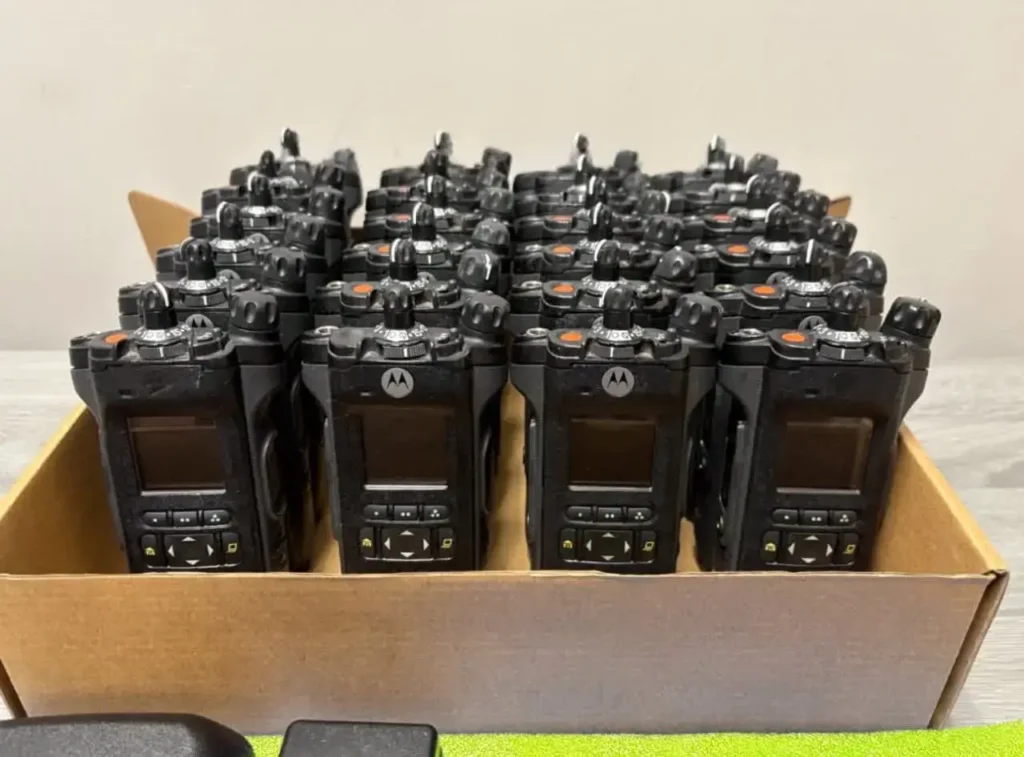
Motorola Solutions is a well-established manufacturer of professional communications equipment. Its two-way radio portfolio includes products designed for commercial users, industrial environments, and public-safety organizations.
Motorola offers several radio families, so buyers should identify the specific model and its capabilities before making a purchasing decision.
Depending on the model, Motorola radios may offer features such as:
Not every Motorola radio includes all these features. Buyers should verify the specifications of the exact model they intend to purchase.
Motorola MOTOTRBO
MOTOTRBO is a family of digital two-way radio products commonly associated with business communications. Depending on the model and system configuration, MOTOTRBO equipment can support digital voice and other professional communication capabilities.
Motorola R Series
The R Series includes professional portable radios designed for different commercial communication requirements. The R2 and R7, for example, serve different feature and application needs, so buyers should compare their specifications rather than assuming they are interchangeable.
Motorola APX Series
The APX family includes professional radios used in public-safety and other specialized communication applications. Some models support P25 technology, but capabilities vary by model and configuration.
Motorola is worth evaluating if you need radios for:
Before choosing a Motorola radio, verify its frequency band, operating modes, programming requirements, accessory compatibility, and compatibility with your existing communication infrastructure.
If your organization already uses Motorola equipment, confirming compatibility with your current radios and system is particularly important.
Explore next: Browse Radio Depot’s available Motorola products and compare the specifications of the models that match your requirements.
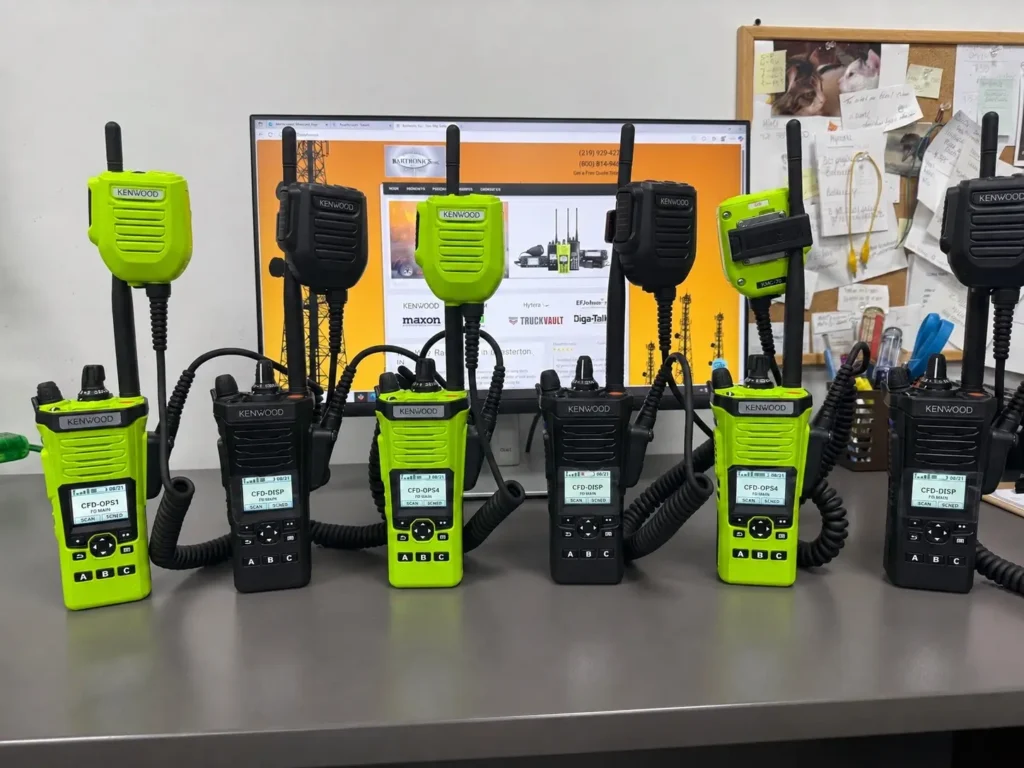
Kenwood offers two-way radios for various communication applications, including commercial radio systems and selected amateur radio uses.
Its professional radio portfolio includes different product families, with capabilities varying by model, frequency band, and configuration.
When evaluating Kenwood radios, consider:
Some Kenwood professional radios support digital technologies, including NXDN or DMR, depending on the model. These technologies should not be assumed to be supported by every radio in the product lineup.
Kenwood NX Series
The NX family includes professional radios with capabilities that vary across generations and models. Depending on the specific radio, supported technologies may include NXDN, DMR, analog operation, or particular combinations of these modes.
Always check the exact model specifications before selecting equipment for a mixed radio fleet.
Kenwood TK Series
The TK designation appears across various Kenwood radio products. Specifications and capabilities depend on the particular model, so the series name alone is not enough to determine frequency coverage or digital compatibility.
Kenwood may be worth evaluating for:
If you are replacing older equipment, check whether the new radio supports the same frequency band, signaling, channel configuration, and operating mode as your current system.
A radio that appears similar externally may not be compatible with the existing network.
Explore next: Compare the Kenwood radios available through Radio Depot and verify their supported features before choosing a model.
Icom manufactures radio equipment for several communication markets, including commercial land-mobile radio, amateur radio, marine communications, and aviation.
Because these markets have different technical and regulatory requirements, identifying the correct Icom product family is an important first step.
The right features depend on your application, but common considerations include:
Some Icom products are designed for commercial operations, while others target amateur radio or specialized applications. These products should not be treated as interchangeable simply because they share the Icom brand.
Commercial land-mobile models may be suitable for organizations that need portable communication equipment for staff coordination.
The appropriate choice depends on the work environment, coverage requirements, radio system, and features required by the organization.
Before buying, check whether the radio supports the frequencies and operating modes authorized for your intended use.
Icom also offers equipment designed for amateur radio operators.
Amateur radio products may have features that are useful for licensed operators, depending on the model and operating mode.
However, an amateur radio is not automatically a suitable replacement for a commercial business radio. The permitted frequencies, licensing arrangements, operating capabilities, and system requirements can be different.
Icom is worth evaluating if you need equipment for a specific commercial, amateur, marine, or aviation application and the relevant product family meets your requirements.
The key is to select a radio designed for the intended service rather than choosing solely by brand.
Explore next: Review the available Icom products at Radio Depot and compare each model against your communication requirements.
Baofeng radios are widely discussed in the budget handheld radio market. Depending on the model, they may appeal to amateur radio operators, hobbyists, and buyers looking for affordable portable equipment for an appropriate, lawful application.
Their price can make them attractive to beginners, but buyers should understand their limitations and operating requirements before purchasing.
Common reasons include:
Features vary across models. Buyers should check supported frequencies, output power, receiver performance, programming methods, and accessory compatibility rather than assuming every Baofeng radio offers the same capabilities.
Baofeng UV-5R
The UV-5R is a widely recognized handheld radio model. Its capabilities depend on the specific version, and buyers should verify its specifications and permitted operating uses before transmitting.
Baofeng UV-82
The UV-82 is another handheld model that buyers may compare with the UV-5R. Differences should be assessed using the exact versions being considered, including controls, supported frequencies, accessories, and other documented specifications.
That depends on the model, the operating environment, and the requirements of the business.
For professional operations, evaluate durability, radio-system compatibility, audio performance, battery life, accessory support, and the availability of appropriate programming and maintenance.
A low purchase price does not necessarily mean a radio will be the most cost-effective choice over its entire service life.
For demanding commercial applications, compare the total cost of ownership and suitability of the equipment rather than focusing only on the initial price.
A radio capable of transmitting on a particular frequency is not automatically authorized to use it.
In the United States, for example, amateur radio equipment must be used in accordance with applicable amateur radio rules, and a business generally cannot use amateur frequencies as a substitute for properly authorized business communications.
Other countries have their own licensing and frequency-allocation requirements.
Before transmitting, check the regulations applicable to your location, radio service, frequency, and intended use.
For official U.S. regulatory information, consult the Federal Communications Commission.
Explore next: Compare available Baofeng models at Radio Depot and confirm that the equipment is appropriate for your intended application.
There is no single brand that is best for every radio user. The right choice depends on the particular models being compared and the communication problem you need to solve.
Here is a practical way to evaluate the four manufacturers.
Start by identifying the radio system your organization needs.
Compare suitable Motorola, Kenwood, and Icom commercial models based on supported frequencies, operating modes, durability, accessories, and compatibility.
Baofeng may be relevant for certain applications, but do not assume that an inexpensive handheld model meets the operational, regulatory, or system requirements of a professional radio fleet.
Choose equipment designed for the amateur radio service and the operating modes you intend to use.
Icom has an established amateur radio portfolio, while Baofeng offers budget-oriented handheld models that appeal to some amateur radio users. Other manufacturers also offer products in this market.
Compare the exact models and verify their technical specifications before deciding.
Consider the total cost rather than the radio’s sticker price alone.
Account for batteries, chargers, programming, antennas, compatible accessories, replacement parts, and any infrastructure your communication system requires.
A cheaper radio may be suitable for a simple application, while a more capable model may be justified for demanding daily operations.
Compatibility should be one of your first considerations.
Check whether the new equipment supports the existing frequency band, channel plan, analog or digital mode, signaling, and other required system features.
Digital radio standards and proprietary features can affect interoperability. Two radios from different manufacturers may communicate under certain configurations, but compatibility should never be assumed without verification.
| Your main requirement | What to prioritize |
|---|---|
| Daily commercial operations | Reliability, appropriate durability, support, and system compatibility |
| Industrial or construction use | Coverage, environmental protection, battery life, and accessories |
| Amateur radio | Supported amateur bands, operating modes, programming, and lawful use |
| Budget-conscious handheld equipment | Suitability, verified specifications, operating restrictions, and total cost |
| Replacing existing equipment | Frequency, protocol, programming, and accessory compatibility |
| Expanding a radio fleet | Interoperability, maintenance, spare batteries, and long-term availability |
Use this framework to narrow your choices before comparing individual products.
Radio technology is another important consideration when choosing between models from Motorola, Kenwood, Icom, and Baofeng.
Analog radios transmit voice using analog modulation, while digital radios encode voice into digital information before transmission.
The practical differences depend on the radio system, technology, and operating environment.
Analog radios can be suitable for straightforward communication systems.
Potential advantages include simpler configurations and compatibility with existing analog equipment, provided the relevant technical settings match.
However, analog performance can deteriorate as signal quality decreases.
Depending on the technology and model, digital radios may provide features such as:
Not every digital radio supports all these functions.
Technologies such as DMR, NXDN, and P25 have different technical specifications and intended applications. Radios using different standards are not automatically interoperable.
If you already operate a radio system, compatibility may be more important than the general advantages of either technology.
If you are building a new system, consider the number of users, communication requirements, infrastructure, future expansion, licensing, and budget.
For additional background, consult Motorola Solutions, Kenwood Communications, and the relevant manufacturer’s technical documentation.
VHF and UHF are two frequency ranges commonly encountered in two-way radio applications.
The best option depends on the environment, available frequencies, antenna requirements, and the radio system being used.
VHF generally refers to frequencies from 30 MHz to 300 MHz.
VHF systems may be appropriate for some outdoor applications, including operations across open terrain, depending on the frequency, antenna, terrain, and system design.
UHF generally refers to frequencies from 300 MHz to 3 GHz.
UHF systems are frequently used in commercial radio applications, including some environments with buildings and indoor obstructions.
However, it is incorrect to assume that UHF always performs better indoors or that VHF is always better outdoors.
Actual coverage depends on many factors, including building construction, terrain, antennas, transmitter power, receiver performance, and interference.
For a business, assess the actual operating environment and coverage requirements before choosing a frequency band.
If your team works across a large industrial facility, a radio coverage assessment may be more useful than relying on general assumptions about VHF and UHF.
Also verify that the frequencies and equipment are permitted for your intended use in your jurisdiction.
A repeater is a radio system that receives a transmission and retransmits it, potentially extending communication coverage when appropriately designed and configured.
Repeaters can be useful when handheld radios cannot reliably communicate throughout a building, across a large facility, or over a wider operational area.
However, a repeater does not guarantee a particular range.
Coverage depends on the repeater’s location, antenna system, terrain, building construction, frequency, power, interference, and the radios being used.
Consider assessing a repeater system if:
Before investing, determine whether the radios support the intended repeater configuration and whether the required frequencies and system operation are authorized.
For larger organizations, professional radio-system planning can help identify the appropriate equipment and antenna placement.
Regardless of the brand, evaluate the following factors before purchasing.
Determine whether you need the radio for commercial operations, amateur radio, marine communications, aviation, or another application.
The intended use determines which types of equipment may be appropriate.
Confirm the supported frequency band and the frequencies you are authorized to use.
A radio that operates on an unsuitable frequency band will not solve your communication problem.
Determine whether your existing radios use analog, DMR, NXDN, P25, or another system.
Confirm that the new equipment supports the required technology and configuration.
Consider the size of the work area, the number of buildings, terrain, obstacles, and whether a repeater or other infrastructure is needed.
Do not choose a radio solely because a product listing advertises a particular maximum range.
Evaluate battery capacity, expected operating time, charging arrangements, and the availability of compatible replacement batteries.
Businesses operating multiple shifts may need spare batteries or additional charging equipment.
For industrial and outdoor applications, consider the manufacturer’s environmental protection ratings and operating specifications.
Look for documented resistance to dust, water, vibration, and impact where relevant.
Check the availability of compatible chargers, antennas, speaker microphones, headsets, programming cables, and software.
Confirm any programming requirements before purchasing.
Include the cost of radios, accessories, programming, infrastructure, maintenance, replacement batteries, and any necessary licensing or authorization.
A complete cost comparison provides a better basis for choosing equipment than the radio price alone.
Choosing a suitable radio starts with understanding your communication needs.
Motorola and Kenwood offer professional radio options across various product families. Icom serves commercial and specialized communication markets, including amateur radio. Baofeng offers budget-oriented handheld models for appropriate applications.
The right choice depends on the specific radio, intended use, technical requirements, compatibility, and budget.
At Radio Depot, our goal is to help customers explore radio equipment and identify products that fit their communication needs.
Before choosing a model, compare the specifications, confirm the applicable operating requirements, and check compatibility with any existing equipment.
Ready to explore your options? Browse Radio Depot’s available two-way radios and accessories, compare suitable models, and contact our team if you need help identifying the right equipment.
The best two-way radio is the one that meets your communication needs without introducing unnecessary cost or compatibility problems.
Motorola, Kenwood, Icom, and Baofeng each offer options worth considering, but the right decision requires more than comparing brand names.
Identify your intended use, determine the required frequency band and radio technology, evaluate the operating environment, and confirm compatibility before purchasing.
Use Radio Depot’s product listings and buying guides to explore available equipment and make an informed decision.
There is no universal winner. Motorola, Kenwood, Icom, and Baofeng offer products with different intended uses, features, and price points. Compare specific models against your requirements before choosing.
Not in every situation. The answer depends on the models, required features, operating environment, system compatibility, and budget.
Some Icom radios are designed for commercial communication, while others are intended for amateur radio, marine, or aviation applications. Choose a product designed for your intended service.
Some Baofeng models appeal to beginners because of their price and availability. Buyers should understand the radio’s capabilities, limitations, programming requirements, and applicable operating regulations.
Sometimes, but not automatically. Compatibility depends on supported frequencies, analog or digital modes, signaling, programming, and other system requirements. Confirm compatibility between the exact models before purchasing.
Digital radios can offer useful capabilities, but they are not automatically better for every application. Consider your existing equipment, required features, coverage, and budget.
Range depends on terrain, buildings, antenna configuration, frequency, transmitter power, receiver performance, interference, and whether a repeater is used. No single distance applies to every radio or environment.
Licensing requirements depend on your country, radio service, frequencies, and intended use. Check the rules that apply to your equipment before transmitting.
Verify the model, condition, supported frequency band, programming status, battery condition, accessory compatibility, and system compatibility. Also confirm that the radio can be lawfully operated for your intended purpose.
Enter your email address below and subscribe to our newsletter